“He has told you, O mortal, what is good; and what does the LORD require of youbut to do justice, and to love kindness, and to walk humbly with your God?” –Micah 6:8.
Why I’m a Mormon Feminist
I’m a Mormon feminist because I take seriously this verse in Micah.
In my mind, to do justice means to recognize the dignity of every human being, and to work towardsa world in which all people, regardless of sex, race, or class, are treated with fairness, respectand afforded opportunities to progress and contribute. As a Mormon feminist, I hope for the daywhen women’s voices are equally included and valued in Church settings. I hope for the day whenMormon women have a greater sphere to act and contribute within the Church. I hope for the daywhen any vestiges of hierarchy between men and women, vestiges which linger in our Mormonpractice, culture, and ideas, disappear. I hope for the day when Mormon women embrace theirlimitless selves without regard to any artificial or constraining ideas of what it means to be a woman.
For me, to act towards these ends is to do justice to my fellow human beings and to do justice to thevision which God has for God’s children. To do so, also, in my mind, is a living expression of kindness,as exemplified by Jesus Christ, who reached beyond the boundaries of his culture to love and includeand feel the pain of those forgotten or despised by the rest of society.
As I journey forward as a Mormon feminist, I also hold closely to my heart that third requirementmentioned in Micah: to walk humbly with God. I interpret this to mean being open to God and theSpirit in my life. I am drawn to the concept of God working within me, working within each of us,prompting us to choose the better part, prompting us to love fearlessly, prompting us to look out for theconcerns of the downtrodden, prompting us to recognize the divinity within ourselves and others. I lovethe idea of God helping us to transcend our petty selves, our narrow constraints, to reach out in radicalfellowship to all.
Because I am drawn to these concepts mentioned in Micah, I am a Mormon feminist. It’s what I believeGod wants me to be.
Lobbying for CARE
One of the women in our Mormon feminist lunch/book group set up a meeting with our Congressman, Jeff Flake. Kay, Holly, and I met with Rep. Flake to discuss international women’s rights issues. Specifically, we were supporting three bills in the Foreign Affairs committee (on which Rep Flake sits). Most of our information came from CARE, an international NGO.
Part of the reason we decided to do this lobbying was because we read Half the Sky for our book group and realized how badly women in the third world are faring. When we met with Rep Flake we asked him if he’d heard of the book, Half the Sky, and he hadn’t. So, I promised to give him my copy when I get it back from my friend. He seemed genuine in his interest to read it.
Holly talked about the MOMS bill, which seeks to address issues of maternal mortatlity rates in third world countries. She told a gripping story of a woman in Africa who, after miraculously getting to a hospital 75 miles from her house, was cared for by inexperienced workers who jumped on her belly to get her baby out. This action ruptured her uterus and without the money, the doctor refused to treat her and after three days of bleeding out, she died.
I didn’t realized that in many countries, 1 of 8 women die in childbirth. It’s incredible. This bill seeks to address the importance of these issues. Of course, with Rep. Flake, and many other legislators, the issues are about funding. “Such sums as necessary” is the phrase used in this bill and that can turn off many a sympathetic Congressman.
Kay discussed a child marriage bill that would require the UN to begin reporting statistics for child marriage, which is any marriage in violation of the country’s own laws. It’s a fairly new bill, without money attached to it, but it could pick up steam if it caught broader attention.
During my few minutes, I discussed the International Violence Against Women Act, which has been introduced every year since 2007.
Call to Action- Responding to Packer
Exponent blogger, Defygravity has issued a call to action regarding Elder Packer’s recent damaging remarks regarding women’s worth. We acknowledge that Elder Packer did not intend to hurt women in his talk. However, we believe that ignoring his comments is not helpful. Instead, we should use his comments as a spring board to open conversations with church leaders of various levels about women’s role in the LDS church and their eternal worth.
For this call to action, we hope readers will
1. Read the remarks given by Elder Packer at the worldwide Leadership Training. The relevant passages are copied below.
2. Respond to local church leaders via phone, in person conversation, or by letter. Defygravity gives her letter in her blog post here.
My personal difficulties with the comments are that they imply that my value as a human is defined by the people in my life, not my relationship with God. As the wife of a worthy priesthood holder, I am very blessed, but this is not something I need my church leaders to tell me, it just is. I need them to tell me that even if my worthy priesthood-holding husband left the church or left me, that I would still be just as worthy, that I am still valuable to God, to the church.
It pains me to think that Packer is preaching to the choir, the lucky people who are happily married and righteous. Are they the ones who need the praise of church leaders? Not according to Jesus. They are usually the ones who need humbling. What about single women, childless women, or those not married to “worthy priesthood holders”? Aren’t they the people who need to be told that God still loves them?
Even setting aside the issues surrounding the worth of women and whether they are their own actors or just suitcases that men carry with them to gain access to heaven, this talk really stings. I hope that the response of women who have been hurt by Elder Packer’s words will help the church understand that it can’t allow language like this to be said in the year 2012. I don’t believe that God feels this way about me or other women, so why would we accept this as the word of God?
I’m not looking for an apology, just a dialogue. What is women’s worthiest role? How about being a follower of Christ? Let’s talk about this with our Stake President, Stake Relief Society President, Bishop, Relief Society president.
As we open these conversations, I believe we will come closer as congregations and give women both power and comfort.
A Dream of Hope
Guest post from reader Corianne Wilson
I had the most beautiful dream last night. In it, I was standing with a group of women and girls, and we were all wearing brightly colored dresses–like jewel-toned versions of the temple gowns. Off to the side there was a group of men, who were calling us forward one by one–starting with the young-women aged girls–and and anointing them with the Aaronic priesthood.
When the brethren became aware of me, they called me over, and I was anointed not only with the Aaronic but the Melkesadic priesthood as well. After the prayers, they embraced me and said “welcome, sister” and I could feel the love and joy that they had that I had finally joined their ranks. I was then asked to assist in the remaining ordinations.
When I woke up, I was feeling the spirit very strongly. And as I reflected on this dream, it wasn’t simply that women were being ordained that made it so beautiful, it was that men and women were working together to build up the kingdom, and that women were put in a position that was truly equal to the men.
My Stake Conference Weekend
Guest Post by Michael G.
I wish you all could have been in my stake this weekend. It was our stake
conference, and I just love the direction that the stake presidency seems to
be trying to go since they were called a little over a year ago.
I first have to say that my world got sort of rocked over the weekend, and I
am trying to come to grips with it. I got called in to the stake president’s
office and was told they wanted to ordain me to high priest. Technically, I
can’t say exactly why at this point, but let’s just say I’m getting a new
calling. It was a very enlightening meeting with my leaders (stake
presidency member and later my bishop). I was honest about my sustaining of
leaders (I don’t think sustaining means I have to agree with everything they
say or do). I was honest that I am not sure I have a 100% knowledge of all
of my testimony, but I am a believer, and I want to help people follow
Christ. They (the leaders) were perfectly fine with my feelings. So that
felt pretty good. Just to give a little more background, I am generally a
liberal thinker politically, and I have openly questioned the church’s
stance on homosexuality, and women’s roles in the church.
Anyway, for stake conference my wife and I attended the adult session on
Saturday night, and the general session of conference on Sunday. It was a
beautiful thing. In the Saturday night session, a sister from our ward spoke
about how she got her children to go to the temple. She has 11 children (7
born to her, and 4 adopted). Of the 11, 6 are of temple-attending age, and 5
of the 6 have been to the temple, while one is completely out of the church.
I loved her talk. She openly admitted that she didn’t really do anything,
rather, she allowed her children to make sometimes wrong choices, but the
five of them eventually were married in the temple. She even admitted not
holding a temple recommend when her first daughter was married in the
temple, and that she then resolved to not miss out on any other of her
children’s marriages. I just loved the honesty. In no way did she try to
imply or show that she “fit the mold.” And I think that was by design. Her
life has been a struggle, but she still has faith in God and in the church.
In the general session two more sisters from our ward spoke. One sister has
been through the death of her first husband, a divorce from her second
husband (that was handled by the Nashville based divorce lawyers ), and she is now on a third marriage. She gave an excellent talk.
She is a counselor in the primary presidency in our ward, and she is a
wonderful lady. The second sister who spoke is married to a man who is not
a member of the church, so she takes her children to church alone. She
teaches the 12-13 year-old Sunday School class. She did a wonderful job, as
well. Both of them were honest about their struggles, and the less than
ideal challenges that they have faced over the course of their lives.
It just struck me that apart from talks given by ecclesiastical leaders, the
other talks were filled by women. This is the same stake that has recently
had a sister come to stake general priesthood meeting to address the
brothers on the importance of home teaching. It is exciting to me that I
feel like the stake is acknowledging openly that nobody – no individual, no
family – is perfect, and that we have amazing sisters in the church. I wish
we could carry this attitude over into the general church body. I know we
still have a long way to go, but it makes me optimistic about the future. I
at least feel like our stake is in the hands of excellent leaders who “get
it,” or at least are trying to think outside the box in some ways.
Thanks for letting me share. Not all Sundays are like this for me, so I am
happy when I am excited about Sunday once in awhile.
CALL FOR ESSAYS- Motherhood
Guest Post by ifrit
Call for your Stories
My spouse and I are writing a book, and we need your help. Please read
the following description of our goals, and if you would like to
contribute, please contact us. Any help you offer will be greatly
appreciated.
On the whole, being a mom is a positive experience for most. However,
there is a stigma (both in the LDS church and the world at large)
attached to the idea that a mother might feel anything but happiness
and contentment regarding her child-rearing duties. It is completely
normal for a mother to feel dissatisfied when spending her time
cleaning up various bodily fluids and riding the wave of one tantrum
after another. A mother needs space, time to pursue hobbies unrelated
to children, church, and home, and the freedom to define herself not
just as a mother and wife, but as a person. We don’t talk about this
enough. We prefer to make jokes of the difficulties involved with
being a mom, or to ignore them in favor of painting a simpler, rosier
picture of a mother’s heart. In this, we do a disservice to mothers
and to their families. For the important work that mothers do, they
deserve more support, and a way to love themselves during the rocky
patches instead of feeling guilty.
Postpartum depression is another issue. It can include many symptoms,
from feeling down for an extended amount of time after giving birth,
to suicidal feelings and recurring disturbing thoughts about harming
the baby. Between 10%-20% of mothers suffer from postpartum depression
The mother has little control over whether it happens, yet when it
does, there is often too little support or understanding to be found
from those around her. Add to this general depression, which strikes
women at a higher rate than men (about 1 out of 8 women suffer from it
at some point in their lives), and we can see the importance of
addressing depression among LDS mothers. It is not enough to tell moms
that they’re doing a great job, that God loves them, and so forth. The
best way to help is to acknowledge and discuss the issue, publicly, so
that moms who suffer (and their families) know that they are not
wrong, or abnormal, or bad, and that there are many resources
available to help them.
Depression, isolation, and dissatisfaction are bad enough problems on
their own, but we make them worse by the way we handle them. Or don’t
handle them, as the case too often is. For a mother to admit
unhappiness is taboo, so mothers who experience difficulty often don’t
realize they are not alone. They feel abnormal, inadequate, or guilty.
These feelings can make depression and dissatisfaction even worse,
damaging the mother and possibly even her family.
Some would say we should not focus on the negative. Motherhood is
important and necessary. Sacrifice, and even some unhappiness, is a
natural part of being a parent, and the results are worth it.
Let’s say I’m making a cake. When it’s done, it’s going to be the
richest, most satisfying cake ever. If I want that batter to get all
cakified, I have to bake it, and for baking to happen, the pan is
going to have to get very hot. But for someone to say, “This hot pan
is the natural state of things; I can’t have my cake without it,” and
then grab the pan without an oven mitt because well, the pan is
*supposed* to be hot…what is the point? Yet how often do we approach
motherhood this way? “You have to sacrifice,” we say. “That’s the
natural state of things. Your kids are worth it.” Yeah. That’s true.
But does that mean we shouldn’t grab an oven mitt and, say, take time
to relax during the baby’s nap? Or tell the kids to fold their own
laundry? Or at least, for Heaven’s sake, acknowledge that the pan is,
indeed, hot? Grabbing it with your bare hands will not make the cake
turn out any better.
It is not just the mother’s feelings that need to be addressed. In a
church where many believe that motherhood is a woman’s highest
calling, even the purpose of her creation, imagine the sadness and
shame a mother would feel when, upon confiding in friends, family, or
church leaders that she feels unhappy, out of control, or dissatisfied
with her life, she might not get the response she expected:
“Motherhood is your divine calling; your unhappiness is a sin. You
need to repent, and then you will feel better.”
“You are crazy.”
“You’re a bad mother.”
“You must have done something wrong. God is punishing you.”
Sadly, these responses are real-life. I’ve run across all of them, and
many more, in my research on this subject. And where the mother does
not hear these things from other people, she tends to fill in the
blanks herself.
There is a real need for more education and more open discussion among
the LDS people when it comes to the realities of motherhood. There are
so many happy, fulfilling things about being a mom, and we should not
forget that. But when we ignore these very real problems, or gloss
over them in favor of presenting a simpler picture, mothers and their
families get hurt. We need to acknowledge that motherhood has real
challenges, and we need to talk about them openly so that the stigma
and the guilt are replaced by understanding and support. Husbands and
older children need to take an active role in making sure each mom
gets frequent time to be the woman she was before she got married and
had kids; to pursue hobbies unrelated to children, church, or home.
“Mother” is only one possible aspect of a woman, and however important
that aspect may be, a woman who is only a mother is not a whole woman.
The book my husband and I are working on addresses these topics and
more. Our point is to let mothers know they’re not alone (something
that came up as important over and over in my research), and to
educate the general LDS public. We’re including anonymous personal
stories and, hopefully, pieces of interviews from well-known LDS women
who are familiar with these issues in one way or another. We hope that
reading about familiar women who are known to be good and active in
the gospel and have experience with the more difficult side of
motherhood will help people realize that experiencing difficulty is
not abnormal or wicked. Many people are (understandably) reluctant to
talk about tough topics like postpartum depression or feelings of
unfulfillment and inadequacy. But the women and families of this
church need those with the knowledge to open up so that we can help
each other heal. If your personal experience or studies have given you
any insight into these subjects, please share it with us! We’re also
looking to discuss the distribution of household work, the importance
of exercise to a mother’s mental well-being, body image, (especially
relating to post-pregnancy and aging), and anything else you think
might be relevant to the happiness of LDS women and their families.
You can email me at mail.for.ifrit@gmail.com, or if you’d like I can
send you a questionnaire, or interview you. Or you can discuss right
here!
Thank you so much for your time.
–ifrit
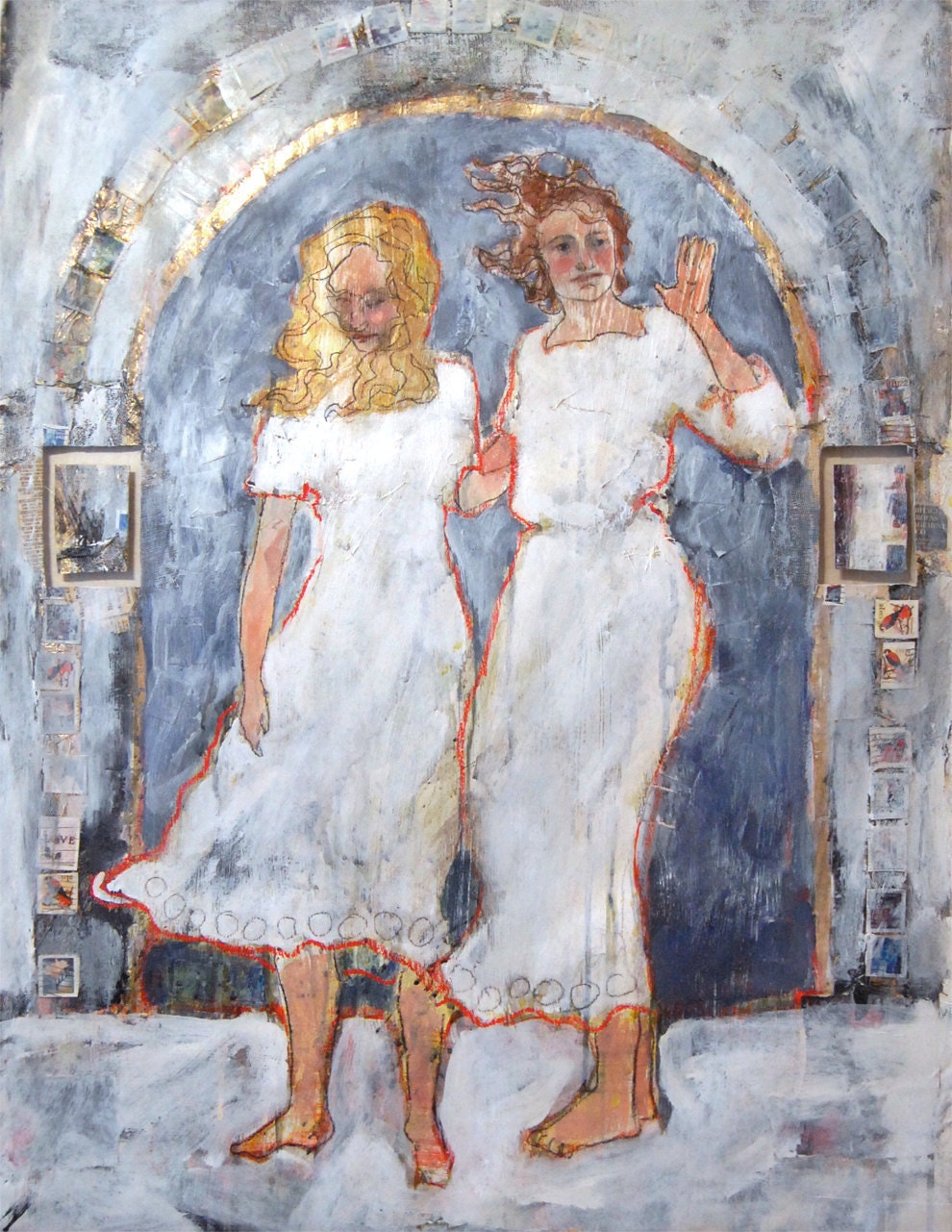
Sister Prints Now Available
If you liked the cover art for the Words of Wisdom booklet, you can go to Galen’s Etsy store and buy a print, 5 x7 for $5 or 8 x 10 for $10, shipping included.
Waking Up, Deep-Down
Guest post by Merrianne Monson
After sensing that my bishop was “waking up” to some deep-down
struggles many women were having with recognizing and realizing their
own worth, and seeing him attempt to fix it by telling all of us that
we are wonderful, I felt inspired to share my thoughts with him. I
share it in part:
“There have been literally hundreds of talks from priesthood leaders
over the years telling women how great they are and that they are not
second-best. For a long time, I always responded to these messages
with a question —- Why do they keep feeling the need to tell us we’re
great? What underlying issues are creating these feelings in women &
why aren’t they getting fixed?
There are many powerful forces throughout the history of the world that
have repeated and accentuated the lie that women are second-best,
second-place, subpar. The “pearl” of the doctrine of Christ teaches
that we, as women, are not second in any way and are on equal footing
with all of God’s children and have equal access to His love, influence
and power. I have come to know and fully embrace this “pearl” and it
has made ALL the difference for me. This piece of truth about who I am
lies at the heart of every single step I’ve taken toward healing,
growth, peace and spiritual abundance.
Though the truth about women is firmly embedded in the doctrine of
Christ, there are pieces of the church that give the message that we
are, at least in some ways, still in second place. I speak from my own
experience when I say that for a woman to overcome these often
unconsciously internalized messages to find the “pearl” of her true
worth and value and power in God’s eyes, she has to dig deep within
herself. The spiritual knowledge of who she really is can only be
found within her own soul, and within the context of her own personal
and intimate relationship with God. Yes, validation from those around
her can help her along that path, but understanding and connecting to
her own God-given potential and power for good is something she
absolutely must do for herself.
I feel a great shift among the women of the church – a shift toward the
discovery, realization and acceptance of our own worth and power, a
worth and power that all of God’s children share as his offspring, but
something that women are finally ready to more fully embrace. Women
are finally beginning to get, deep in their gut, that their worth and
potential is not tied to the many roles they play or don’t play (wife,
mother, etc), but is simply tied to who they are as a child of heavenly
parents. I see many priesthood leaders (including yourself) who are
beginning to sense the tremendous pain caused by women not
understanding or embracing their inherent worth and power for good. I
appreciate your (and others’) sensitivity to the spirit and desire to
help women find help and healing. That healing will come as priesthood
leaders become more sensitive to and more validating of the needs and
unique gifts women have to offer but, more importantly, that healing
will come as women discover the truth about who they really are for
themselves. It will come as they rise up and choose that healing for
themselves and for all the women around them. As I have seen in my own
life, this healing blesses each woman, her family, and eventually all
those within her circle of influence. Nothing can match the power that
is unleashed when a child of God finds out who they really are.
I pray you will receive these thoughts in the spirit they were given.
I hope something I’ve shared will help you understand, a little more,
how to best help the amazing women in our ward find their own greatness
and live up to it.”
He thanked me for the email, and said it was very helpful to him. I
absolutely know that experiences like this, of choosing to speak up and
speak authentically, are what will create healing change.
Mother’s Day
For some wards, Mother’s Day is awesome, in others it’s not so great.
Check out the recent Exponent thread, Mother’s Day The Good, The Bad, and The Ugly, about Mother’s Day 2011.
This thread can help articulate some of the reasons Mother’s Day is difficult for many women and some examples of success and failure that happen in the LDS church on this holiday.
Tracy’s Story
by Jessica
I’d like to highlight Tracy M’s story at By Common Consent about her experiences being a divorced mother in the LDS church.
You can read her story here and feel free to comment on the thread at BCC.

