Spotlighting LDS Humanitarian Services

Last month, I highlighted the book, website and global effort called The Life You Can Save which advocates for people all over the world to donate 1 % of more of their income to causes working to alleviate global poverty. If you are interested in viewing a list of the causes that the website and others suggest, visit: the page Organizations you can give to and suggested organizations. Because I didn’t see LDS Humanitarian Services suggested by readers, I submitted it. It will hopefully appear on the site soon.

Then I read the article in September 2010 Ensign “The Church’s Humanitarian Efforts: Discipleship in Action” highlighting their efforts over the last 2 decades.

It’s always a good idea to do some fact checking into an organization before you donate money to them. You want to be sure that the money you are giving actually goes to the people they claim to serve and that the work that is done by the organization achieves its intended outcomes. The Ensign article helped me know more about LDS Humanitarian Services and see that they are actually involved in much more than I originally had thought.

To be honest, my perception of LDS Humanitarian Services for a long time was that they were really good at what I term the “band-aid” approach. In times of natural disaster or when providing aid to struggling communities, I believed they provided quick fixes that helped temporarily but did not address underlying causes contributing to the need for aid. Those efforts are necessary and important but after awhile its like pouring water into a bucket with holes when the help needed is a plug for those holes.

This Ensign article showed to me that the church does work to address the causes of poverty. The efforts described were: building wells to provide clean water that improves sanitation and increases productivity; providing wheelchairs to people with impaired mobility enabling them to be more involved in their care and support; treating and diagnosing vision problems in areas without adequate access to health care; training birth attendants in neonatal resuscitation to save babies’ lives; and address underlying causes of hunger, disease and malnutrition by teaching agriculture and livestock techniques.

A chart provides an impressive run down of the effects of LDS Humanitarian Services:
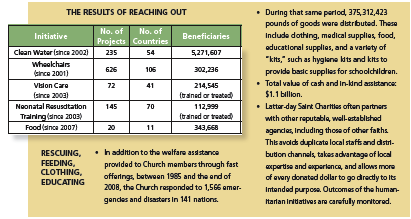
Impressively, the church reports that in the last 23 years, LDS Humanitarian services have contributed $1.1 billion in funds and 375,312,423 pounds of goods were distributed. These include clothing, medical supplies, food, educational supplies, and a variety of “kits,” such as hygiene kits and kits to provide basic supplies for school children.

I am encouraged to learn these things about LDS Humanitarian Services and feel that I can recommend the organization for their efforts to fulfill the mission of alleviating global poverty. When you go to pay tithing, please consider donating up to or more that 1% of your income to LDS Humanitarian Services to sustain and participate in their efforts.

To learn about other ways to be involved, visit: the How Can I Help? page. One of the suggestions is to serve in your local communities with organizations also working on efforts to alleviate poverty. Another suggestion is to become a service missionary or short-term specialist.

I dream of the day when my husband and I can service couple service missions for the church. In talking with the Humanitarian Services, there may be opportunities for parents of young children to be involved with short-term projects that may only require 1-2 weeks at a time a couple of times a year.

What else do you know about LDS Humanitarian Services? Have you be involved in any service projects with them? Can you recommend involvement with them? How would you like to be involved or which areas would you like to see them address?

Call to Action: Starting Halloween Boycott Nestle

Guest post by: Courtney Cooke lives in Boise, Idaho with her three strong willed daughters, infant son and highly supportive husband. Courtney blogs at The Exponent Blog as CorkTree. She is passionate about science and natural health practices and hopes to merge those with her feminist vision by going into practice as a midwife when her children are all in school.

Women in impoverished countries have little that provides them autonomy or allows them the ability to care for their family and children outside the influence of men.  Many of them do not have choices in birth control and whether or not to breastfeed their children.  So it would seem benevolent of a company to come in and provide them the means to give their infants nourishment outside themselves.  Formula can be a blessing, when made and used properly and for the right reasons.  But what if that company took advantage of these women?  What if it paid other needy, untrained women to dress up as health care workers and pass out free samples of sub par formula?  And what if they gave only enough free formula so that the milk of the nursing mothers dried up and they were forced to purchase more formula, but had to mix it with unclean water and dilute it to make it last longer?  And what if many of the children that fall victim to this malicious scam were actually dying while their mothers stood by helpless and dry, all because they were no longer able to breastfeed as nature intended, and were unable to see how they were being exploited?  Would you be outraged at such a company?

This is what was happening prior to 1977, when the world launched a boycott against Nestle for these unethical and immoral practices.  After a brief hiatus, the boycott has been continued to this day because of continued aggressive marketing campaigns and violations of the WHO code that protects women and children.  It is estimated that 13% of the deaths of children under age five around the world could be prevented by increased breastfeeding.  That’s 1.4 million children that would otherwise die due to the interruption of the natural nursing relationship.

Support is still needed to send Nestle the message that we as women of the world will not stand for our sisters and their children to be undermined and threatened in this way.  Regardless of how we may feel about breastfeeding in our own lives, it is not empowering to women in third world countries to have a bottle put between them and their babies.  Promoting artificial feeding where no reason exists for its implementation is damaging to all and causes needless suffering and death.  Nestle is one of the largest producers of baby food and formula as well as a variety of other products.  Please do not support them with your money.  And this Halloween, choose your candy wisely.

For more information and to register your support, please visit; http://info.babymilkaction.org/nestlefree .  A list of all products and brands from Nestle can be found at;  http://www.nestle.com/Brands/BrandHome.htm , and for an independent listing of all products associated with the Nestle label, visit;   http://crunchydomesticgoddess.com/2009/10/07/the-updated-nestle-product-boycott-list/

WAVE Statement of Compassion for Homosexual Brothers and Sisters

The Women’s Service Mission recognizes the struggle and hardship of members of the church who experience same-gender attraction. The hand of fellowship is extended to these, our brothers and sisters. In recent weeks and years, the topic of homosexuality in the LDS church has been a divisive one, leading to much heartache. We recognize this heartache and mourn together.

To those gay Mormons who are striving to remain faithful, the WAVE Women’s Service Mission offers encouragement to continue your efforts. Please know that we welcome you in our congregations and value your presence and contributions to our wards. We admire your faithfulness and humble submission to the commandments.

To those who are not keeping the Church’s standards in regards to homosexuality, you too are welcomed in our congregations and we value your presence and participation in our wards. For those who are trying to abide by the church standards, we hope that you will find what is right for you and continue to seek the guidance of the Spirit in your actions. We pray with you that answers and the peaceful assurance of the Spirit will be forthcoming to you.

There is much we still do not understand about the role of homosexuality in our heavenly parents plan in bringing “to pass the immortality and eternal life of man” [and woman] but we have hope all that will be revealed and God’s will be done.

In honor of Spirit Day, instituted yesterday October 20, 2010, and acting in accordance to the counsel stated in the October 12 press release issued by the Church of Jesus Christ of Latter-day Saints, we join with the Church and many others who decry bullying and cruelty to our homosexual brothers and sisters. We appreciate the reminder: “Our parents, young adults, teens and children should therefore, of all people, be especially sensitive to the vulnerable in society and be willing to speak out against bullying or intimidation whenever it occurs, including unkindness toward those who are attracted to others of the same sex.”

We know the compassionate response is never to harass or belittle the efforts of others but to support, encourage and love them as they are. Gay Mormons deserve the respect from others to make decisions for themselves.

WAVE and the Women’s Service Mission invites readers and sympathetic church members to join with us in our message of support and encouragement to gay Mormons. Please add your name and location (ward and stake if you are comfortable) in the comments. Anonymous submissions are welcome though personal expressions of support are encouraged. You may also email service@ldswave.org to be added to the list of signees.

Action Opportunity: Acting Now to End World Poverty

Last month, our family went on a cruise to Alaska. It really was an enjoyable trip but as I was thinking of the luxury of the experience I also thought of the life situations of many around the world that is so opposite from what I was experiencing. I’ve become more aware of global poverty and my role in being the change I want to see in the world that I knew if I could afford a trip like that that I could also afford giving more to alleviate the poverty of many through out the world. I started thinking about what I could give. It really was a vague thought while on this trip and one I knew I wanted to continue pondering.

Then this last week, like an answer to a prayer, I heard on NPR an interview with Peter Singer who wrote “The Life You Can Save: Acting Now to End World Poverty” which is his call to the people of the world to give a portion of their income to causes working to address global poverty. The website The Life You Can Save provides a calculator where you can find out what 1% of your income is (since I assume most WAVE readers earn less than $105,000 USD a year) as well as a list of organizations that are addressing poverty in a sustainable and community building way.

It was a bit of a wake up calling knowing that 1% of my income is less than what my family spends in eating out at restaurants each year (blush…) and yet its also a good lesson that giving to causes that actually make a difference in the lives of people is more possible than I had thought.

One of the organizations named on The Life You Can Save website is the Worldwide Fistula Fund which helps repairs physical damage to a mother caused by prolonged labor and lack of access to emergency maternity care in poor countries. The documentary A Walk to Beautiful highlights what is like for a woman who becomes completely incontinent as a result of childbirth and how she becomes an outcast in her community as a result. The treatment is estimated to be about $450 to restore a woman where she is able to rejoin her community.

Another organization that has come highly recommended to me is The Hunger Projectbecause it assists an entire village for five years. This one is highly attractive to me as it focuses on an entire community rather than an individual or family.

I am also familiar with the humanitarian work that the LDS Church does and I know that in addition to providing immediate emergency relief in natural disasters, they also work on community building in poverty stricken areas around the world. I look forward to the day when my husband and I can serve humanitarian service missions. Perhaps I’ll be able to put my midwifery training to use in this way.

In taking a look at my finances, I know this is something that I can do even in addition the tithing that I pay on my family’s income to the church. In viewing the comfort and opportunities available to me and my children, I know that it is something I should do. I also believe that exploring the various types of bank accounts can help me manage my money more wisely and support these financial commitments more effectively.

I took the pledge on The Life You Can Save and used their calculator to figure out what the guidelines are for my income level. I am encouraged by the stories of the people on the site who report that they can comfortably give more than the recommended guideline even on low incomes. One man from the UK makes the equivalent of $25,000 a year and finds he can donate 5% of his income to global poverty efforts.

Have you heard of this idea of widespread societal giving? What do you think? Will you take the pledge? Which organizations do you feel drawn to support? How have you worked with other Latter-day Saints on humanitarian efforts?

As always, WAVE invites readers to submit their own experiences with volunteer and charitable efforts. Please share your stories of being involved in efforts to relieve global poverty by emailing service@ldswave.org.

Being Aware: Its Not All Pink

This was submitted by WAVE reader Jenni R. Brighton, co-founder of The Amethyst Network, a non-profit organization providing resources and support to women experiencing infant loss or miscarriage.

October is National Breast Cancer Awareness Month. This is a fact widely acknowledged in the media and everybody seems to get on board with everything from all-night cancer walks to facebook status games. My grandmother is one of those “1 in 8 women” who has been diagnosed with breast cancer, as are dear family friends, and I have joined those all-night walks and regularly remind my blog-readers to do their self breast exams.

However, October after October, I notice that the flood of awareness is decidedly (and almost exclusively) pink. It seems that we either overlook or are unaware of the many other “Awareness Months” going on in October.

Yes, 1 in 8 women will be diagnosed with breast cancer in their lifetime. However 1 in 4 women will experience a miscarriage or infant loss, and 1 in 3 will be a victim of domestic violence.

But nobody talks about how October is Pregnancy & Infant Loss Awareness Month, or Domestic Violence Awareness Month, even though both of those things are more common than breast cancer. About 1 in 20 women will be diagnosed with Gynecologic Cancers, and while the incidence rate is lower than breast cancer, the mortality rate is higher (over 1/3 do not survive). So shouldn’t we talk about that, since October is also the month of Ovarian Cancer Awareness and Uterine Cancer Awareness?

It’s also Lupus Awareness Month, and Childhood Cancer Awareness Month, and SIDS Awareness Month, and Down’s Syndrome Awareness Month, and Celiac Disease Awareness Month, and Spina Bifida Awareness Month, but nobody seems to be talking about those either.

For more complete lists, see here or here. There are so many great causes to get involved with; let’s not fixate on just one.

While we’re on this topic, I’d like to put in a brief word about productive activism. I think that Facebook status games do not really raise awareness any more than the Farmville updates do. Think about how you would feel if it were you sitting in chemo: would you be more appreciative of a hand-knit chemo cap from a stranger, or of all your friends posting facebook status updates saying where they put their purses? What if your spouse was beating you? Or if your child had died? Wouldn’t you appreciate real support over passive games?

So I recommend posting a thoughtful (not copied!) message about an important cause. Blog about what matters to you and what you can do (or are doing) to help. Better yet, donate money or goods or time to an organization, and then post about what you did on your blog and share with others.

Are you involved in one of the causes observed in the month of October? What have you done to raise awareness, contribute to the cause or address these important issues impacting women and their families? How have you personally been affected by the October Awareness Month issues? Please share your experiences by commenting below or emailing service@ldswave.org.

Advocacy Opportunity: Support the Paycheck Fairness Act

Join with WAVE and MomsRising to tell your legislators that you want to see equal pay for equal work.

Just take 30 seconds to send a letter to your Senators with 1-click now:

http://action.momsrising.org/go/422?akid=2342.262765.EKgoNz&t=4

From MomsRising:

  • Data recently released by the U.S. Census found that women who worked full-time, year round on average still made 23 cents less for every dollar earned by their male counterparts. (This marks no change from 2008’s wage gap and amounts to nearly $11,000 per year in lost earnings).  And, the wage gap for women of color in 2009 was even more staggering than for women overall. When Black and Hispanic women work full-time, year round, they only make 62 and 53 cents, respectively, for every dollar their white, non-Hispanic male counterparts earn. [1]
  • Last week, the Government Accountability Office (GAO) released a report which found that mothers who are working in management positions earned 79 cents for every dollar earned by fathers who are managers, unchanged from 2000.  Further, in 12 out of the 13 major industries, fathers were more likely than mothers to be managers. [2]
  • Also last week, The Wall Street Journal reported: “…the pay gap could easily create a retirement savings shortfall of hundreds of thousands of dollars. Consider this example of a female and male manager, both 50 years old and looking to retire at 65.  She makes $81,000, he makes $100,000 in 2010, and each gets a standard 2% annual raise.  Not only will he end up earning more than $350,000 than she did over those 15 years, he’ll also end up saving 23% more for retirement– even though both contributed 10% of their income to their retirement funds each year and got a 5% average annual rate of return.” [3]
  • Earlier this week, Bloomberg News reported: Women managers in finance, a group that includes bank tellers as well as executives, earned 63.9 cents for every dollar of income men earned in 2000, based on median salaries, according to Government Accountability Office statistics analyzed by Bloomberg. In 2007, the last year for which data are available, the figure was 58.8 cents. The 41-cent gap was the biggest in any of 13 industries surveyed by the GAO, and only two others had a widening disparity.” [4]

Sadly, this unequal pay is a contributing factor to why now a full 1 in 7 people in the U.S. live in poverty, [5] as well as to the fact that nearly 1 in 4 kids in our nation are experiencing food scarcity due to family economic limitations. [6]

In this tough economy, more and more families are counting on women’s earnings. Unfair pay practices make things even harder. The Paycheck Fairness Act would deter wage discrimination by closing loopholes in the Equal Pay Act and barring retaliation against workers who disclose their wages to coworkers.

[1] U.S. Census Bureau and  NWLC: “State Wage Gap Data Show Little Or No Improvement from 2008”

[2] U.S. Government Accountability Office: “Women in Management: Analysis of Female Managers Representation, Characteristics, and Pay”

[3] The Wall Street Journal: “For Women, Pay Gap Means Retirement Shortfall”

[4] Bloomberg News: “Wall Street Says Women Worth Less as Disparity Over Pay Widens”

[5] U.S. Census Bureau: “Income, Poverty, Health Insurance Coverage in the United States: 2009”

[6] The Washington Post: “America’s economic pain brings hunger pangs”

MomsRising is also asking the question:

Have you ever experienced wage or hiring discrimination?  We’re pulling together stories of MomsRising members across the nation to share with U.S. Senators.  Share your story here (and feel free to share anonymously): http://action.momsrising.org/go/423?akid=2342.262765.EKgoNz&t=8

WAVE wants to hear too. If you write something to submit to MomsRising, share it with us here too. How has wage or hiring discrimination affected you as a Mormon woman?

How I’m a Mormon Feminist

Just before the time when I needed to choose my educational path as a freshman in college, I was baptized and became a member of The Church of Jesus Christ of Latter-day Saints.  As I embraced my newfound values, I found inspiration in the church’s teachings on families and how the answers to the problems facing society seemingly could be found in the gospel. Encouraged by the scriptures and the value the church puts on education “by study and also by faith,” I sought the answers from science and scholarly study and found that much of what social scientists have found contribute to happy and healthy families are also foundational teachings in the gospel.

BYU and The School of Family Life was the perfect place for me to understand this connection. There I was trained to become an activist for family friendly public policy and was encouraged to continue my scholarship and work.

When I had joined the church, my mother worried if her strong-willed and passionate daughter was up to the challenge of living the traditional role of a Mormon woman. I was pleasantly surprised to see that this stereotype did not always bear out in my observations of women in the church. At BYU, I found many examples of LDS women who were balancing the dual callings of mother and professional. I had hope and faith that the Spirit would guide me to the roles that I would play in my family and community though I did not understand how it would work.

As I came close to completion of a graduate degree, it was revealed to me in a blessing that the path I thought my life would take was different that what my heavenly parents intended. Just as I was expecting to hear counsel to be solely devoted to my family and raising my children, I was encouraged to continue my studies and activism. That was the last thing I expected to hear!

That blessing made me realize that I was going to be atypical in the church.  After a shocking birth experience where my right to informed consent was threatened and ultimately withheld, losing my job while on maternity leave and being thrown headlong into the Mommy Wars, I learned first-hand some of the discrimination and hurdles that complicate motherhood. I started to view family policy from the perspective of a mother and became aware that women’s efforts to provide for themselves and their families are still very much devalued in our society.

I was inspired to continue my work as an activist and found ways to work from home as a stay at home mother. In addition to completing a master’s degree with a child on my hip and another in utero, I collaborated with the non-profit, Solace for Mothers, to create an online discussion board for women who were struggling with emotional trauma caused by their childbirth experiences, and volunteered with the organization The Coalition for Improving Maternity Services to promote The Birth Survey, a consumer feedback website reviewing maternity care providers.

Currently enrolled in midwifery school and with plans to pursue a doctorate degree in the future, I find strength in the teachings of the gospel, the stories of women of the restoration and reliance on personal revelation.

Advocacy Opportunity: Prioritize Maternal Health in Millennium Development Goals

Giving life should not mean risking death. – Amnesty International

The goal of the United Nations Millennium Campaign is to end global poverty by the year 2015. In 2000, 189 heads of states and national representatives signed the Declaration affirming that we have the ability to “free our fellow men, women and children from the abject and dehumanizing conditions of extreme poverty, to which more than a billion of them are currently subjected.”

The eight Millenium Development Goals (MGDs) are:

  1. End poverty and hunger
  2. Universal Education
  3. Gender Equality
  4. Child Health
  5. Maternal Health
  6. Combat HIV/AIDS
  7. Environmental Sustainability
  8. Global Partnership

A petition from Change.org is working to remind President Obama of  the United State’s commitment to partner globally to end poverty and specifically make global maternity mortality a priority. According to the framers of the petition:

“Women’s health is at the heart of all MDGs.

In Africa and South Asia, complications during pregnancy and childbirth are the leading cause of death for women of childbearing age.

New data released in September 2010, shows a 34% reduction in global maternal death rates since 1990.  With just 5 years left to achieve the MDGs, we still have a long way to go to reach the global target of 75% reduction in maternal death.”

In fact, women in sub-Saharan Africa face  a 1-in-22 chance of dying from complications of pregnancy or childbirth. When all developing nations are assessed together, the odds are 1 in 75. According to newly released estimates on maternal mortaility in 2005, 536,000 women in the developing world die of maternal causes each year — a death every minute. And for every woman who dies, another 35 to 40 suffer debilitating injuries.

Only one in 17 births in Ethiopia is attended by a trained professional. For the poorest fifth of the population, such assistance is even rarer; fewer than 1 in 100 births involves a doctor, nurse, or midwife. These births often take place in rural areas that lack clean water and sanitation. If labor is obstructed or another complication arises, as happens in about 15 percent of all births, little can be done to help the baby or mother.(Nova Two Worlds)

To learn more about maternity care issues in developing countries, watch the documentary “A Walk to Beautiful” viewable on PBS.org

To keep up to date with the UN Millennium Campaign, find them on Facebook and join their email list.

The solutions, according to researchers are simple. For the cases of obstetric fistula experienced by the women in A Walk to Beautiful, only $450 is needed per patient. Education for girls and women is another answer. Experts at the World Health Organization, Population Reference Bureau, and elsewhere “point to education as a key way to address the abysmal state of maternal health in many developing countries. Education can ameliorate the root causes—poverty, the low status of females, and lack of understanding and access to reproductive healthcare. And educating girls and young women does more than improve the lives of mothers; it enhances the well-being of children, entire families, and broader communities.”

Maternal mortality is not just an issue in the developing world, but also one of concern in the United States as well. In 2006, the maternal mortality rate in the United States was estimated as 17 deaths per 100,000 births, higher than most other developed countries. It is also believed that the mortality rate is severely underreported in the United States and could be much higher. There is concern over the mortality reporting system and a call for more accurate reporting  measures to be in place.

WAVE readers are invited to add join with over 1,000 other concerned citizens in signing a petition to Congress to improve maternal mortality reporting and addressing the rising maternal mortality rate in the United States. Please also add your voice in support of global issues by signing the petition regarding the global maternal mortality rate and learn about ways that you can assist the UN in their goals to alleviate global poverty.

Thanks to the Church Humanitarian efforts, you can likely do this through your involvement with the LDS church and other volunteer efforts. If you are interested in joining with other Latter-day Saints to address maternal mortality, please comment below. If you are involved in or become involved in efforts to address maternal mortality on the national or global level, please share your experiences by emailing service@ldswave.org.

Organizational Spotlight: Parenting in the Workforce Institute

Let’s start with a couple rhetorical questions:

Is the primary reason LDS women are counseled to stay home to care for their babies and children because the workforce historically does not allow parents to bring their children to work with them?

If yes, what if the workforce changed and started welcoming mother-baby dyads into the office or onto the sales floor for those mothers feeling led to work outside the home?

Some companies are doing that, over 140 across in the United States, in fact. The list of organizations can be found at the website Babies at Work.org sponsored by the Parenting in the Workforce Institute.

The vision of Parenting in the Workforce Institute is stated as follows:

We are prepared to enable a dramatic expansion of this world in which babies come to work every day with their mothers or fathers and in which parents can lovingly care for their children while also getting their jobs done:

A world in which bank tellers and grocery store employees cuddle their babies while helping clients, and customers come to the businesses more often specifically to visit the babies

A world in which coworkers and managers start out skeptical about starting a babies-at-work program, but then find themselves bonding with the babies and wanting them to continue coming to work

A world in which parents can stay with their babies and work to support their families at the same time

A world in which both men and women in the workplace provide a social network for these new families and volunteer to help care for the babies

A world in which the business benefits of these programs are so significant that executives rave about how integral a baby program has been in the success of their business

A mother works at the computer while babywearing

In a call for support I found posted on Stand and Deliver, a blog about mothering, pregnancy and childbirth written by LDS woman Rixa Freeze, PhD, the founder of PWI is seeking people who will:

1.   Join the PIWI Network.  Whether you’ve taken a baby to work, work in a baby-inclusive company (or want to), or are simply supportive of our efforts to build a world in which families of all kinds are supported, we would love to hear your experiences and opinions.  Joining is free, and you can choose to donate $30 if you wish to receive a PIWI mug and a seal for your website to show your support.  We are also starting a PIWI Blog Network for advance notice of PIWI initiatives and opportunities to participate in blog carnivals and other events.  If you wish to join the Blog Network, please enter your information when you join our Network.

2.   Tell Companies About Our Bridge Project.  Spread the word to current baby-inclusive companies that might be interested in joining the Bridge Project—the first wave of our plans to celebrate and expand babies in the workplace.  Companies who join the Bridge Between Career and Family will have their baby program permanently featured on our website and will receive free initial baby-inclusive certification services and a discount on services to enhance the effectiveness of their baby program, outreach avenues for sharing their products and services with Institute supporters, an outlet for finding skilled employees among PIWI supporters, and priority for being included in future media pieces.

3.   Follow PIWI on Facebook and Twitter. Join our Facebook community and Twitter page; we will be communicating frequently in the upcoming days with our supporters there as well as on PIWI Place, our private community for PIWI Supporters.

4.   Grow Our Baby-Inclusive DatabaseTell us if you know of companies anywhere in the world that have allowed an employee to bring a baby to work (even informally) so that we can contact them and add them to our list.  Share with us your suggestions of companies that might be willing to work with us to set up a formal babies-at-work pilot program (at no charge for the Institute’s services).

5.   Expand Our Outreach.  Write and talk about parenting in the workplace–show the world that this is being done successfully in many different environments.  Send us your pictures and videos of bringing your babies to work.  Spread the word about our effort to bring parenting at work to the mainstream, and share your own experiences and thoughts about this concept.  Let us know when you post your work and we’ll do our best to share your thoughts with other supporters of parenting in the workplace.

For more on information on PWI, look for pictures, videos, interviews, and survey results on their Babies in the Workplace website, this blog, and their Facebook and Twitter pages, as well as through various other outlets that support their work, such as MomsRising with their new website, the Custom-Fit Workplace. Also keep an eye out for Rixa’s interview of PWI’s founder Carla Moquin.

For other innovative and child-friendly employment policies, check out MomsRising’s Open Flexible Work page where they discuss flexible work arrangements like flexible scheduling, telecommuting, job sharing, career customization, part-time work options and, on-ramps for parents who take time away from work in addition to taking babies to work.

If you had the opportunity to take your baby to work, would you do it? Have you been able to take your baby to work or arrange any of these other flexible work options? How did it work for you? How did it go with your baby? If you took your infant to work, what did you and your employer decide once your baby became mobile?

Advocacy Opportunity: Support the National Women’s History Museum Act

Originally posted on Change.org.

The National Women’s History Museum was founded in 1996 by Karen Staser. However, it has been limited to a virtual presense. Museum staff are hoping to make their drream of a physical location a relaity in the near future. The museum would like to showecase such historical items as the original, signed 19th Amendment to the Constitution, the 1848 Declaration of Sentiments from Seneca Falls, and some of the tens of thousands of women’s history items belonging to the Smithsonian Museum of American History that have never been displayed.

Despite the fact that the museum will be privately funded, the NAtional Women’s History Museum need Congressional approval to buy the federal land on which they want to build. The U.S. House of Representatives passed The National Women’s History Museum of 2009 back in October and sent the bill over to the Senate. Frustratingly, it has sat there collecting dust for almost a year because a male Senator put an anonymous hold on the bill.

There is no need to delay this important project any longer. Until a site can be secured, it is nearly impossible for the National Women’s History Museum to properly plan and raise funds. Tell your Senator now that you want them to fully support the National Women’s History Museum Act.

To sign the petition, you can visit the National Women’s History Museum’s website and sign their petition urging Senator to pass the act: http://www.nwhm.org/get-involved/promote/sign-petition/

From their site:

“Our Nation’s Capital has many wonderful museums, but one important museum is missing–one to recognize and honor the lives of women. Help us build the National Women’s History Museum by signing our petition.”

As the first advocacy opportunity posted by the Women’s Service Mission, please choose to act as you feel appropriate with this information. If you are in support and want to sign the petition, please do so. You may also decide that this is one project that is meaningful to you and that you may wish to find ways to be further involved. If you do, visit the NWHM’s website’s “Get Involved” page where they describe their different needs for volunteers and support.